Galaxie experimental platform
To better control fire risks in nuclear facilities and assess their consequences, the ASNR conducts research at its GALAXIE platform. This platform brings together a range of shared equipment that is made available to scientific teams for conducting studies under controlled conditions. The facilities include oxygen-enriched rooms and confined, mechanically ventilated environments, enabling the collection of data essential for analysing fire-related phenomena.
DIVA
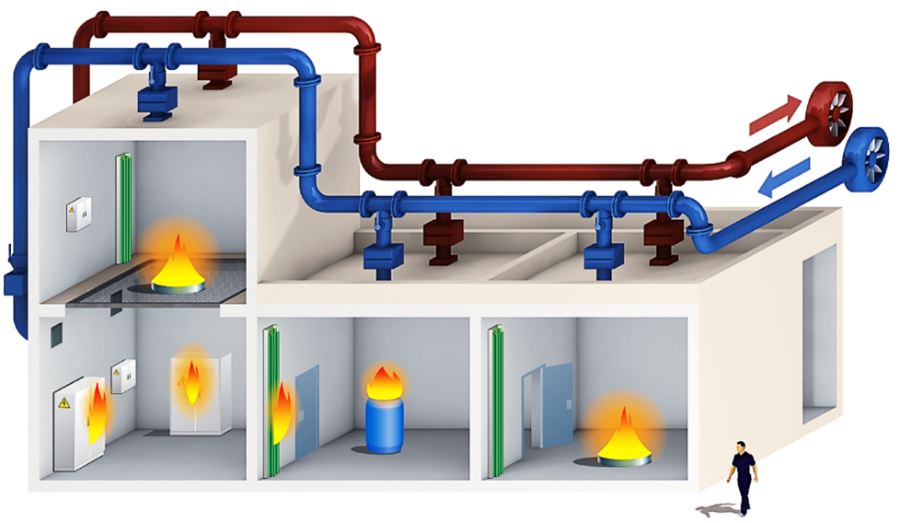
DIVA (Dispositif incendie ventilation et aérocontamination) enables highly instrumented fire tests to be carried out in configurations involving several confined and mechanically ventilated rooms, which are likely to affect nuclear facilities such as laboratories and factories, as well as pressurised water reactors (PWRs).
The objectives of this facility are to assess the consequences of a fire in a "multi-room" configuration:
-
Changes in pressure, temperature and nature of gases in the facility
-
Smoke propagation between different rooms (doors, valves, floor openings, etc.) and impact on the facility and its equipment
-
Interactions between the fire and fire mitigation systems
-
Fire-ventilation interactions
Characteristics
-
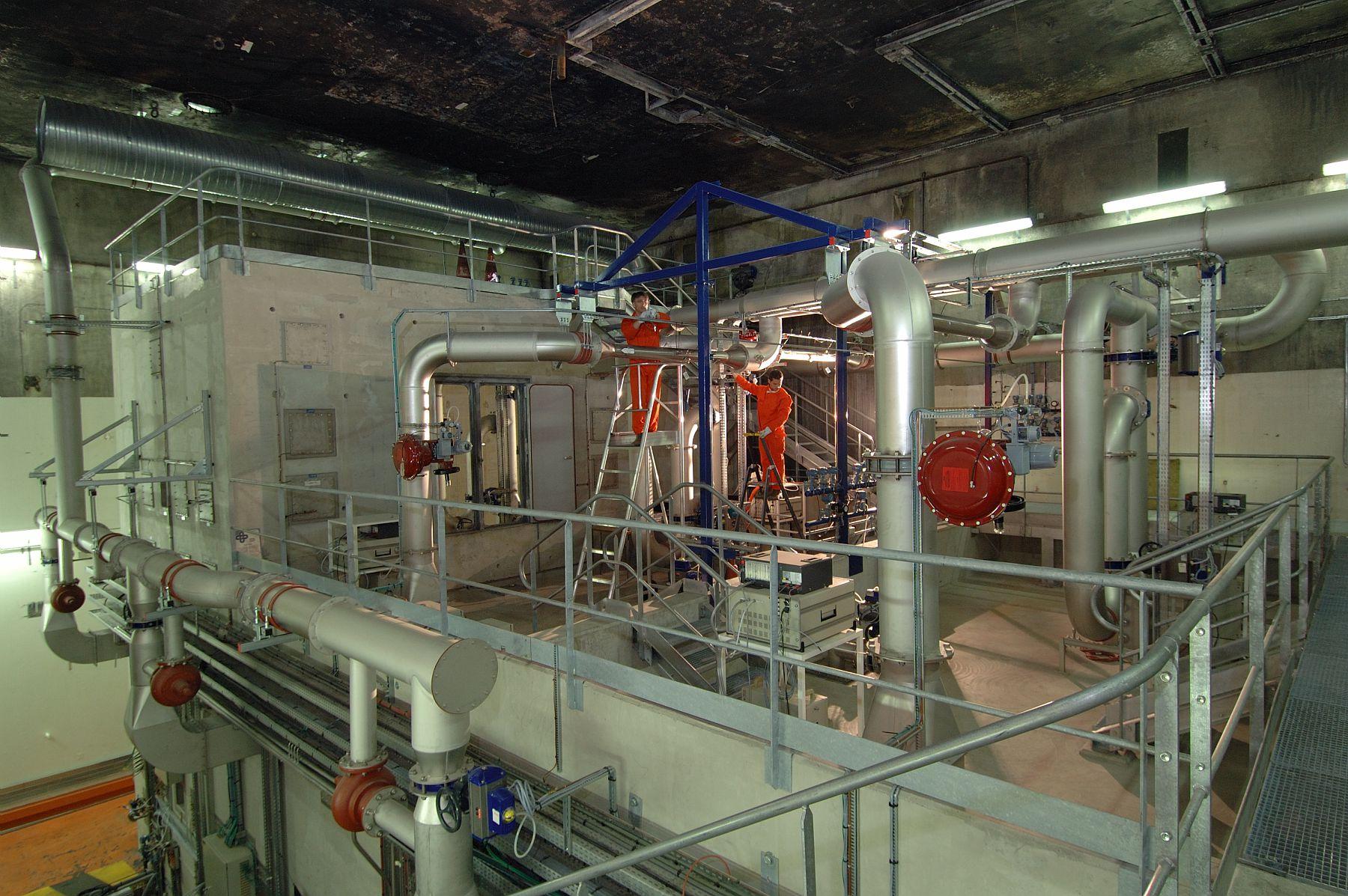
Walls: ~ 35 cm reinforced concrete
-
Watertight steel doors
-
Operating pressure: -100 hPa to +520 hPa
-
Controlled leaks between rooms via doors or openings
-
Walls protected by sacrificial concrete
-
Thermally insulated ceiling
-
Room volumes: 120, 150 and 285 m³
Instrumentation
Over 2,000 online measurement channels + control and command:
Thermocouples, pressure sensors, gas analysers, heat flux sensors, speed sensors, flow meters, soot analysers, electronic scales, videos
PLUTON
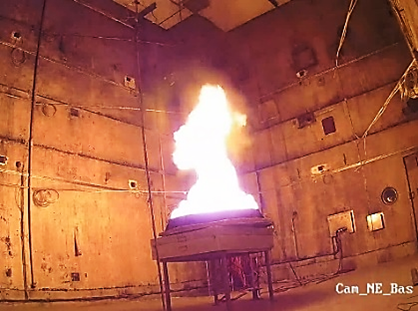
This experimental facility is a large-volume chamber connected to a complex ventilation system, enabling the simulation of high-power fire scenarios in various configurations representative of fires that could occur in nuclear facilities:
-
Changes in pressure, temperature and nature of gases in the facility
-
Under-ventilated fires in confined atmospheres
-
Fire propagation to targets
-
Malfunction criteria in representative configurations
-
Fire-ventilation interactions
-
Fire-sprinkler system interactions
Characteristics
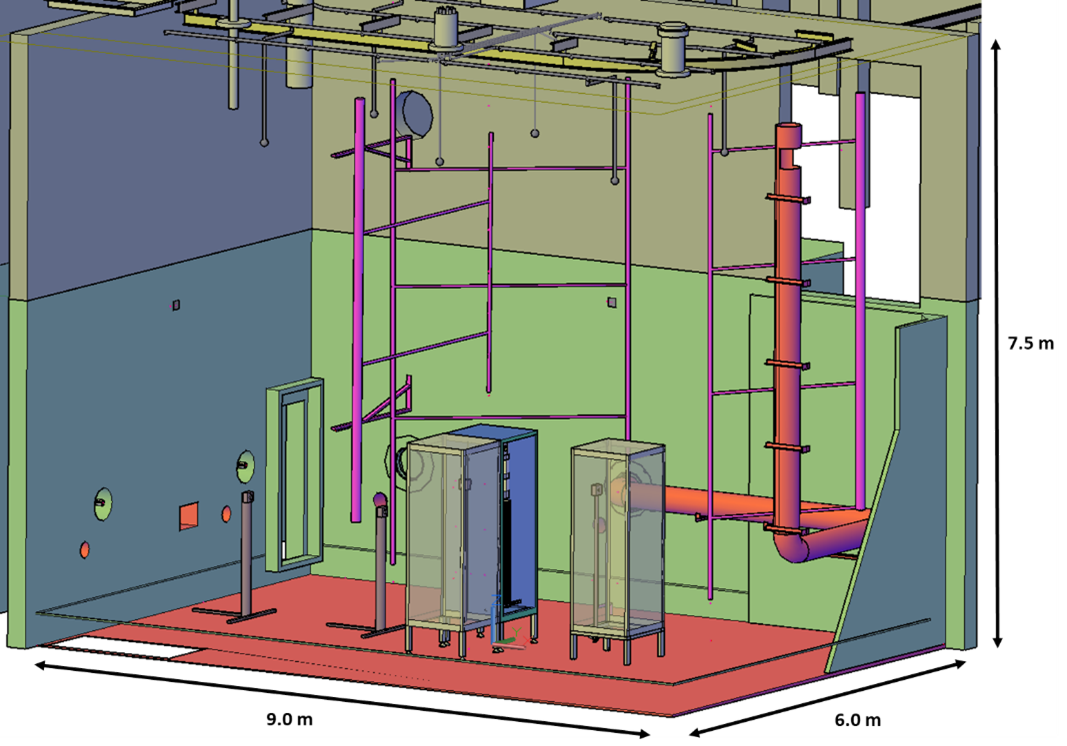
- Volume of 405 m³ , dimensions: 6 m (W) x 9 m (L) x 7.5 m (H)
- 25 cm thick reinforced concrete walls
- Operating pressure: -50 hPa to +250 hPa
- Complex ventilation system with air blown in or extracted from the top or bottom of the compartment
Instrumentation
More than 500 online measurement channels: thermocouples, pressure sensors, gas analysers, heat flux sensors, velocity sensors, flow meters, soot analysers, electronic scales, videos.
SALSA_P sampling line in the extraction duct, to characterise the suspension of contamination involved in a fire
SATURNE
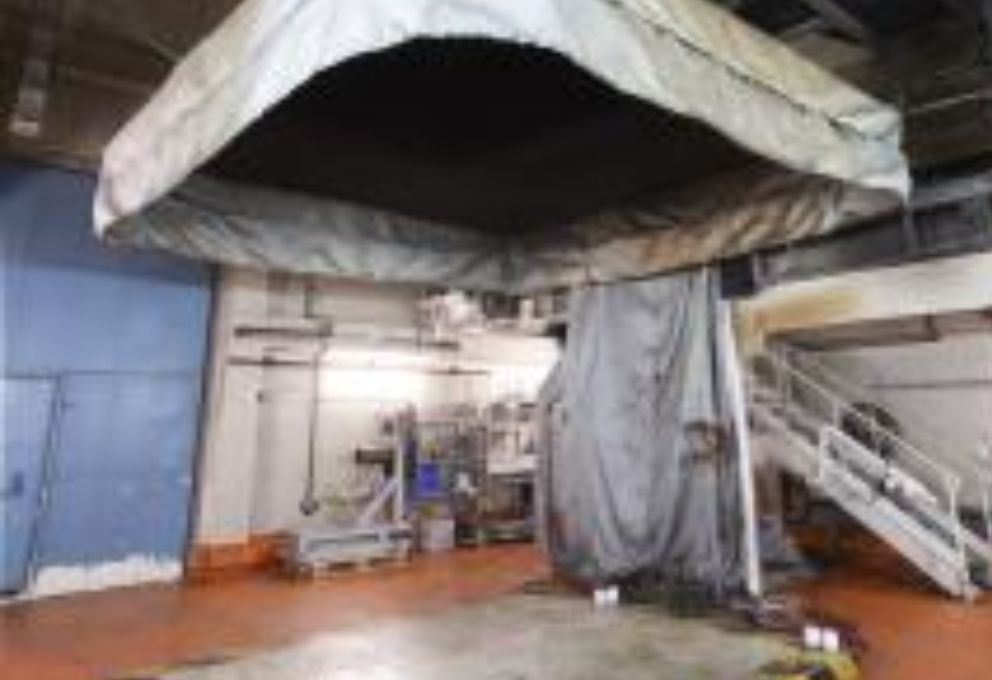
The large-volume (2000 m3) SATURNE facility, which is well ventilated and equipped with a large-scale calorimetric hood, allows fire tests to be carried out in open conditions (without oxygen limitation) to achieve maximum fire development. It allows the maximum fire power to be characterised for a wide range of fuels (cable trays, electrical cabinets, etc.):
-
Analysis of the thermal impact of fires (heat flux) on structures and safety equipment,
-
Reference fire power to feed into fire safety studies and supplement fire tests carried out in confined and mechanically ventilated environments (DIVA and PLUTON facilities).
It also aims to study the spread of fire on complex fuels (electrical cabinets, waste drums, glove boxes, etc.).
Characteristics
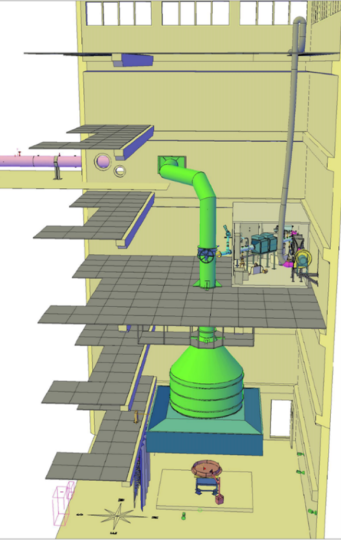
- 100 m²floor space and 20 m height (SATURNE tower)
- 30 cm thick reinforced concrete walls
- Calorimetric hood with 4.5 m sides
- Maximum ventilation flow rate of 40,000 m³/h
- Maximum fire power of 4 MW
- SALSA_S line 10 m above ground level (suspension study)
- Downstream measurement duct (air flow, gas and soot measurements)
Instrumentation
Thermocouples, flow meters, pressure sensors, velocity sensors, flow meters, gas analysers, electronic scales, IR camera, aerosol metrology (membrane filters, SALSA_S electric filters, online analysers, etc.)
CISCCO
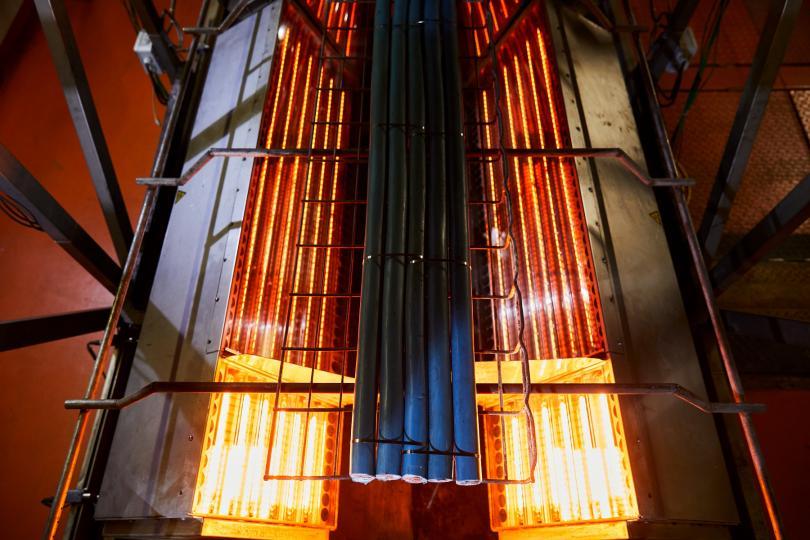
The CISCCO device is used to study pyrolysis and fire propagation on combustible surfaces (electrical cable trays, polymer sheets, etc.) that are preheated and arranged horizontally or at an angle. It enables the development of a database to propose and validate correlations and models of pyrolysis and propagation. The parameters measured by the installation include: flame and fuel temperature, fire spread rate, heat flux, fuel mass and pyrolysis mass flow rate, fire power and growth rate.
Characteristics
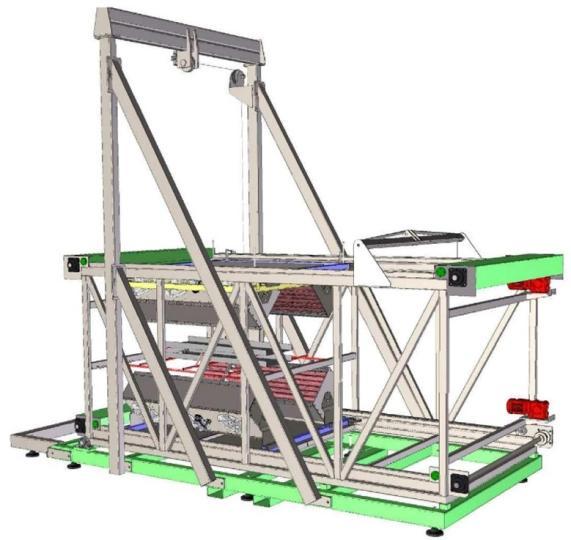
- Exposure area for upper and/or lower radiant panels that can impose heat fluxes of up to:
- 70 kW/m2 to control its ignition at one of its ends
- 30 kW/m2 to preheat it (20 to 400 °C) and study the spread of fire over a length of 1 m
- Retreat area to accommodate radiant panels after testing or those (upper or lower) not used during testing
- Combustible surface and radiant panels that can be tilted up to 45° using the bracket
MARS
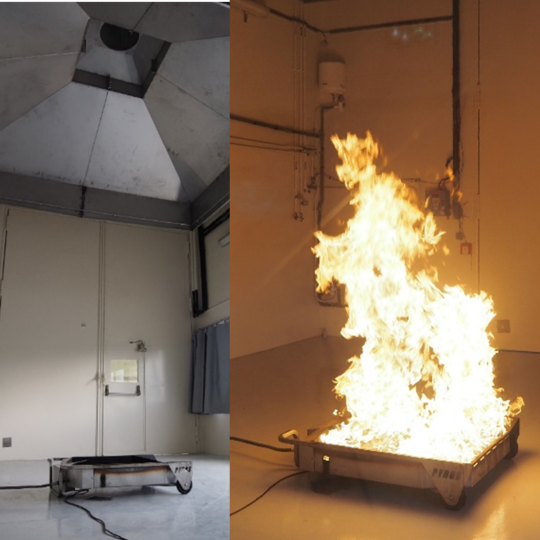
This experimental facility is equipped with a smoke extraction hood, used to determine the specific parameters of medium-scale fires in an open environment. The purpose of the MARS facility is to enable the development of advanced non-intrusive experimental methods.
The MARS facility allows:
-
The study of medium-scale fires in open environments
-
The characterisation of fire sources for all types of fuel (gas, liquid, solid)
-
The implementation of advanced non-intrusive experimental methods: particle image velocimetry, infrared camera systems, ombroscopy
Specifications
-
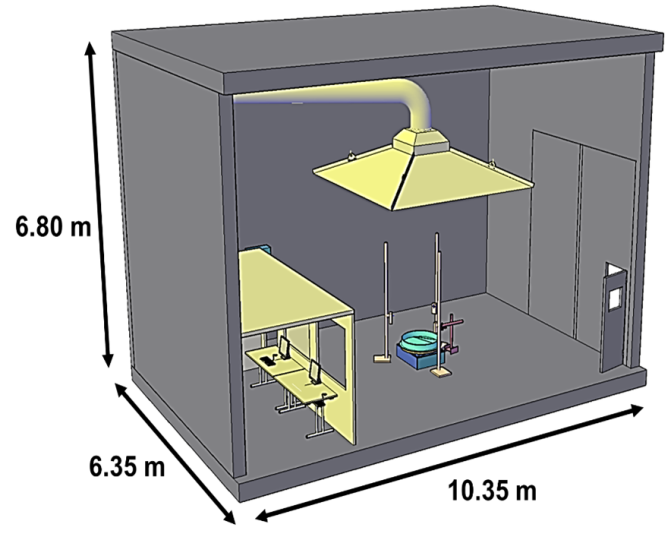
65 m² floor space and 7 m height
-
Reinforced concrete walls
-
Square section hood 4 m x 4 m
-
Maximum permissible power: ≈1 MW
Instrumentation
Thermocouples, pressure sensors, gas analysers, heat flux sensors, velocity sensors, flow meters, soot analysers, electronic scales, videos
NYX and STYX
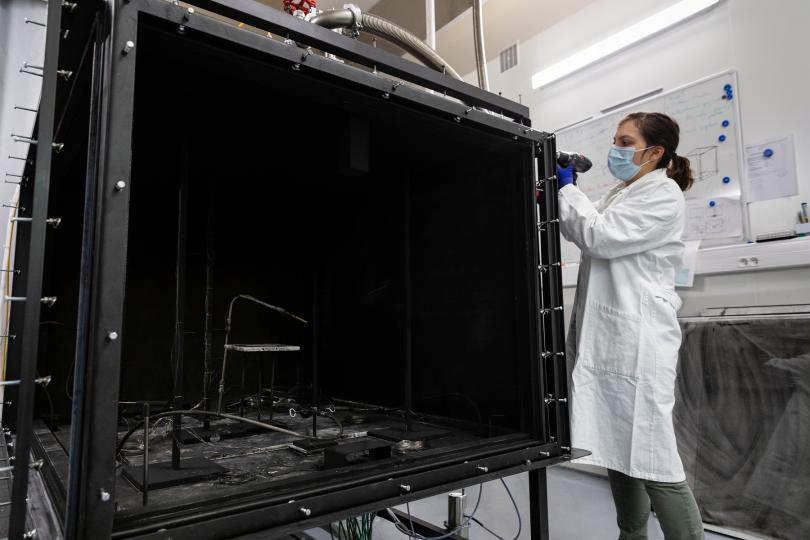
The NYX and STYX devices are small-scale enclosures designed to provide a detailed understanding of fire scenarios in confined, mechanically ventilated spaces. The small scale allows for the use of advanced measurement techniques such as particle image velocimetry (PIV) and OH radical chemiluminescence.
The subjects studied include the circulation of smoke or fresh air through doors or vents, combustion in under-ventilated conditions, and the combustion of high fires.
The devices are modular and allow the study of the characteristics of the ventilation network (flow rate, position of vents), the fire (gas, liquid or solid fire, position in the room) and the nature of the walls.
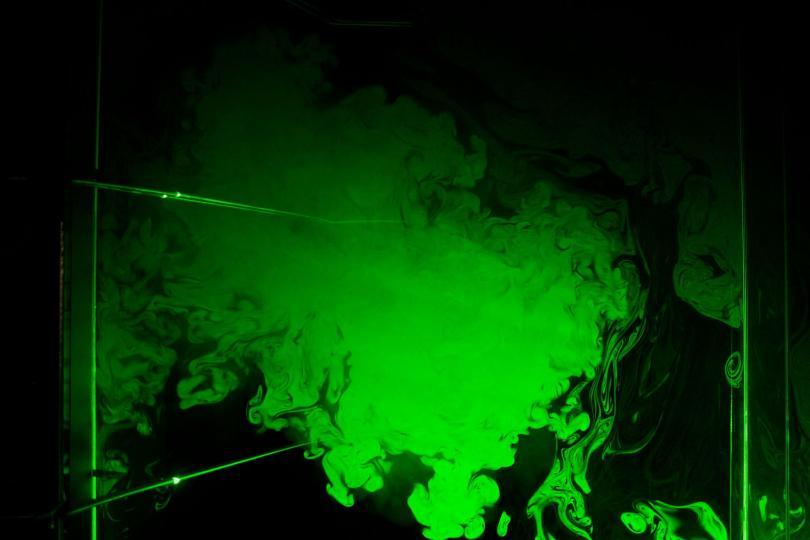
- NYX: V = 1.85 m³ (l = 1.5 m/W = 1.25 m/H = 1 m)
STYX: 2 communicating rooms V = 1.5 m³ (l = 1.5 m / L = 1 m / H = 1 m) and V = 1 m³ (l = 1 m / L = 1 m / H = 1 m) - Modular walls (steel, thermal insulation material, glass)
- Optical access
- Mechanical ventilation system with intake and exhaust ducts equipped with fans
- Fuel: gas, liquid, solid, maximum permissible power 20 kW
- Measurement techniques: Temperature, gas analysis (O₂, CO₂, CO, soot, unburned gases), heat flow, video, PIV, OH chemiluminescence, infrared thermography
DANAIDES
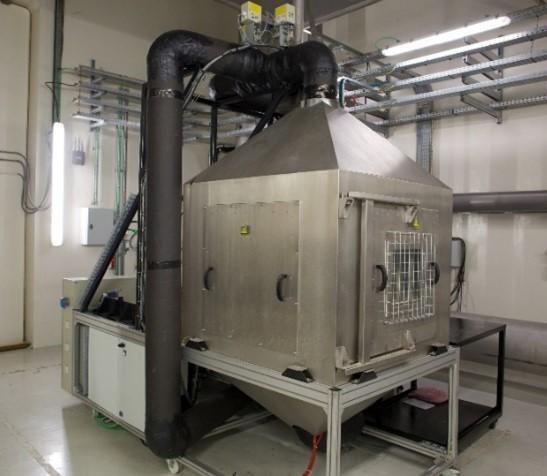
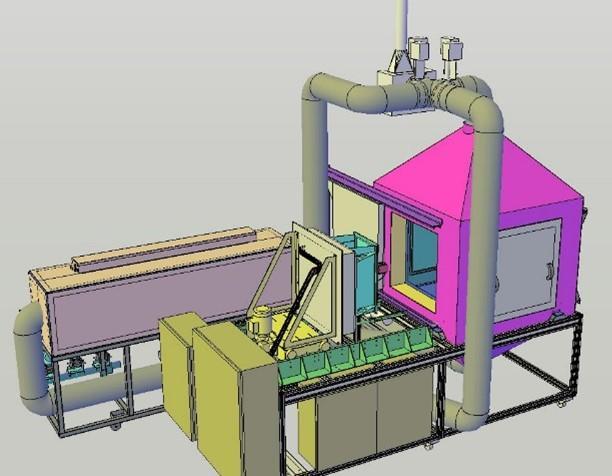
DANAÏDES (Analytical device for studying electrical malfunctions caused by soot in the event of a fire) is used to characterise malfunctions in electrical equipment subjected to thermal stresses and/or aerosol (soot) concentrations representative of fire conditions by measuring changes in electrical input and output signals. Malfunction criteria are determined for several types of equipment and different configurations.
Characteristics
-
Gas temperature: up to 300 °C
-
Particle concentration: up to 5 g/m3
-
Measurements of electrical input and output signals
-
Stainless steel chamber
-
Insulated stainless steel ventilation ducts
-
Closed-loop gas flow from 50 to 250 m³/h
-
Calibrated carbon particles representative of fire soot
-
Soot particles from fires conducted in various facilities at the GALAXIE platform
Instrumentation
-
Thermocouples
-
Electrical measurements taken on the devices
-
Volume concentrations of soot (sequential sampling and online analysis)
-
Pressure sensors,
-
Flow meters
CADUCEE
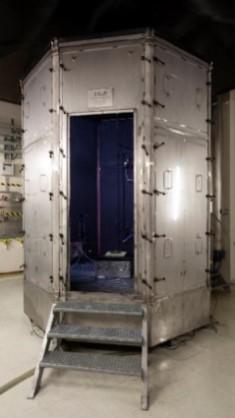
The CADUCEE (Controlled Atmosphere Device for Unburnt and Carbon Emission Evaluation) device is used to create fires in a controlled atmosphere with low oxygen content and under an additional external incident and controlled heat flux in order to quantify the influence of these two controlled parameters on the main combustion parameters (pyrolysis rate, fire power, radiation, flame temperature) for different types of fuels. The ultimate goal is to establish correlations for use in fire models.
Characteristics
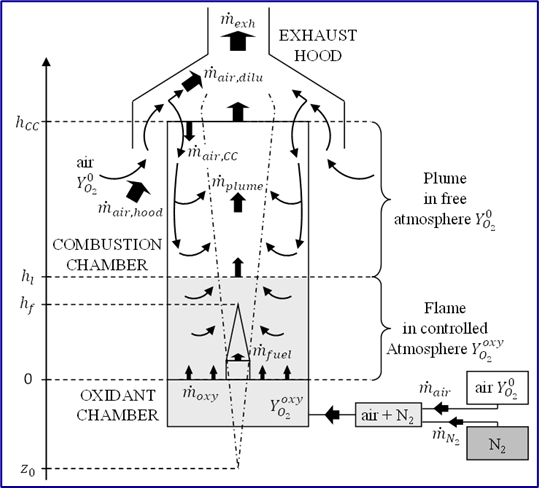
- Octagonal stainless steel combustion chamber (7 m²surface area x 3.1 m height)
- Oxidant injection (air/N₂ mixture) in the lower part of the combustion chamber (up to 5,000 m³/h)
- Smoke extraction (up to 15,000 m³/h) via a square hood (25 m²)
- Fire (gas, liquid or solid) up to 250 kW
- Radiant source (28 carbon IR lamps) up to 30 kW.m⁻²incident on the fuel
Instrumentation
- Electronic balance
- Flow meters
- Video cameras
- Thermocouples
- Gas analysers (O₂, CO₂ and CO)
Around the platform
Software platforms are also linked to this group, offering tools for processing, simulating or analysing experimental data. Several laboratories use these resources in their work. The platform has also been used in research projects. The list below shows the units involved and some examples of projects that have used the platform for their experimental or digital components.
Among the laboratories involved are:
- Fire Experimentation Laboratory (LEF) French
- Fire and Explosion Laboratory (LIE) French
- Confined Space Fire Research Laboratory (Etic) French
- Experimental Equipment Production Laboratory (LR2E) French
The platform has been used in several research projects, including:
- Prisme-FAIR
- FIGARO
- PIC-FEU
In addition to the experimental facilities, the software platform linked to GALAXIE:
S3AFER, including the Sylvia software.