PRISME-FAIR Program
The PRISME (Fire Propagation for Elementary Multi-location Scenarios) and FAIR (Fire Risk Assessment through Innovative Research) programmes are international research programmes led by the IRSN and subsequently by the ASNR under the auspices of the OECD.
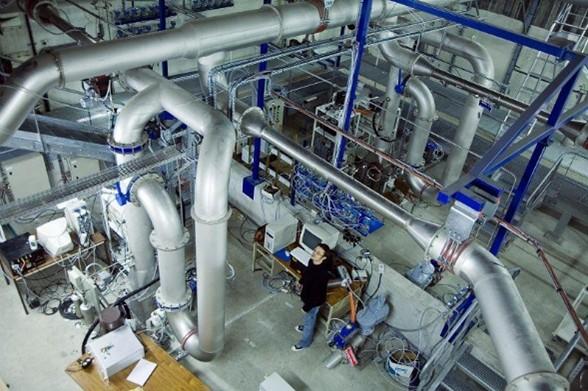
The experimental work is carried out on the ASNR’s GALAXIE experimental platform.
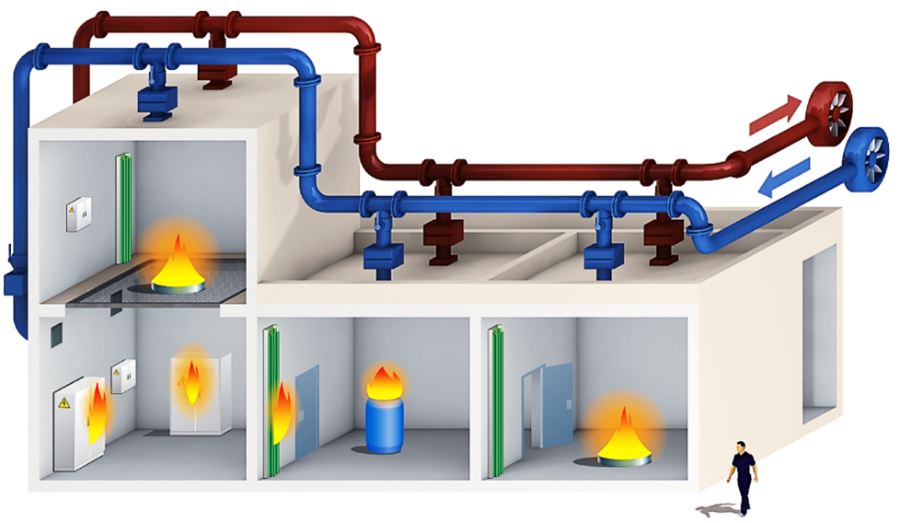
These programmes experimentally study, on the one hand, the spread of smoke released by a fire in a nuclear facility via openings between rooms and the ventilation system. On the other hand, they study the behaviour under oxygen-deprived conditions (confined and ventilated rooms) of real fire sources (electrical cabinets and cables).
The PRISME programme was divided into three successive phases:
- PRISME 1 (2006 to 2011)
- PRISME 2 (2011 to 2016)
- PRISME 3 (2017 to 2022)
Following PRISME, the FAIR programme began in 2023 for a duration of five years, continuing and expanding on the work undertaken.
In parallel with the experimental work, Analytical Working Groups (AWGs) were established. These working groups bring together experts from partner organisations and facilitate discussion on methods of modelling, simulation and interpretation of the data obtained.
For the ASNR, this work represents a major contribution to the validation of the fire simulation software within the S3AFER software platform.
FAIR
Project characteristics : Programs carried out under the auspices of the OECD, with the ASNR acting as the operating agent.
Project duration : June 2023 – 2028
Funding : €3.7 million
Partners :
- BEL V, TRACTEBEL-ENGIE (Belgium)
- VTT (Finland) until the end of 2025
- EDF, FRAMATOME, ASNR (France)
- GRS (Germany)
- NRA (Japan)
- KAERI, KHNP, KINS (South Korea)
- CSN (Spain)
- ONR (United Kingdom)
- ENSI (Switzerland)
- CERN (EU)
Publications :
- March, P., et al. FAIR: A New OECD/NEA Fire Risk Research Project Under Development as a Follow-Up to PRISME 3. Proceedings of SMiRT 26
- Nerisson, P. et al. OECD/NEA FAIR (Fire Risk Assessment Through Innovative Research) Project: Progress Two Years After Project Launch. Proceedings of SMiRT 27
Background :
The main objective of the FAIR project is to obtain additional or complementary data to that produced by the three PRISME programs, in order to improve fire risk assessment in nuclear facilities.
Its scientific scope was defined on the basis of the conclusions of a PIRT (Phenomena Identification and Ranking Table) exercise. This exercise, conducted with partners from the former PRISME projects, identified topics of common interest, both in terms of safety issues and knowledge requirements.
On this basis, the FAIR program is structured around three research areas :
- Fire propagation along cable trays
- The effects of hot and contaminated environments on fires in confined and mechanically ventilated compartments
- Complex multi-source and multi-compartment fire scenarios.
The FAIR project’s experimental campaigns are carried out at the ASNR’s GALAXIE experimental platform in Cadarache, providing an experimental setting representative of the conditions encountered in nuclear facilities.
-
Fire propagation along long cable trays
The first focus area of the FAIR programme aims to better understand fire propagation along cable trays, whether vertical or horizontal, in confined and mechanically ventilated compartments.
An initial series of large-scale tests focused on fire propagation along vertical cable trays. These tests were carried out in 2025 at the DIVA facility, using a 6-metre-long vertical cable tray, in order to study both the spread of the fire and its consequences in confined, ventilated spaces.
A second series of tests, also on a large scale, focuses on fire propagation along long horizontal cable trays. This complements the campaign conducted as part of PRISME 3 CFP (Cable Fire Propagation), which was carried out in the DIVA facility’s test tunnel using 6-metre-long horizontal cable trays.
These tests have shown that the use of longer cable trays is more suitable for avoiding any edge effects and thus allows for more thorough validation of analytical models. Taking into account feedback regarding the DIVA safety criteria, new tests using 9-metre-long cable trays will be carried out in 2026 in the DIVA facility corridor.
Effects of cable ageing on fire behaviour
The FAIR project also examines the effects of ageing on electrical cables, and in particular on sheathing materials (insulation), on fire behaviour and fire spread. Two test strands are proposed :
- Part 1: natural ageing
This phase aims to analyse the fire behaviour of naturally aged cables in order to obtain representative results. The main challenge is to be able to collect suitable cables from nuclear facilities: cables that are neither contaminated nor activated, and for which the fire resistance standards were initially known and complied with.
- Part 2: artificial ageing
This part aims to analyse the fire behaviour of artificially aged cables. This allows for a wide selection of cables and the choice of ageing sources. However, the main challenge lies in specifying representative accelerated ageing test protocols.
A selection of candidate cables has been made in accordance with the above specifications. The first ageing tests will take place in 2026. -
Combustion in hot and vitiated atmospheres
The second focus area concerns the study of fire behaviour in hot and vitiated environments, characterised by low oxygen concentrations and high temperatures.
The aim is to analyse the combined influence of oxygen depletion and increased gas temperature, or external heat flux, on fire development as well as ignition and extinction conditions.
To this end, the FAIR programme employs a dual experimental approach :
- large-scale experiments, designed to replicate realistic fire scenarios
- medium-scale experiments, with a more analytical focus, to support the understanding of large-scale test results and contribute to the development of a modelling methodology.
An initial series of tests carried out in 2024 includes large-scale experiments in a mechanically ventilated chamber at the DIVA facility. The aim is to replicate scenarios in which external heat fluxes to the fuels are significant and can offset the negative effect of oxygen contamination. Typical examples include fires in cable trays or electrical cabinets beneath the ceiling, submerged in the smoke layer.
A second series of medium-scale experiments was carried out in 2024–2025 in a controlled-atmosphere facility. Simple fire sources are considered (liquid pool). The intermediate experimental facility under consideration is the NYX test facility.
Ignition of unburned gases
Building on the lessons learned from the PRISME 2 project, the FAIR project aims to gain a better understanding of the smoke explosion phenomenon, and more specifically, the conditions that promote the formation of a premixed gas mixture and those that lead to deflagrations.
In fact, smoke explosion phenomena were observed during large-scale cable tray fire tests conducted as part of the PRISME 2 experiments.
Several deflagrations, characterized by overpressures exceeding 100 hPa and rapid flame propagation, occurred without any sudden change in ventilation.
Consequently, smoke explosions cannot be excluded from fire safety analyses of nuclear facilities. It is therefore planned to conduct medium-scale experiments, which are more conducive than large-scale experiments, to characterize the conditions under which deflagrations occur and develop. -
Propagation between discrete sources
The third research area focuses on propagation between several discrete sources within the same environment, leading to the movement of the fire source within the compartment or the occurrence of several simultaneous fires.
This campaign will include large-scale experiments conducted on the GALAXIE platform, focusing on both real-world configurations and academic scenarios (confined atmosphere using the DIVA facility or open atmosphere using the SATURNE facility).
The practical configurations will cover two fire propagation scenarios:
- vertical spread, mainly driven by convection due to smoke movement
- horizontal propagation, mainly driven by flame radiation.
The aim of this approach is to focus on the physical mechanisms involved and to propose academic cases for code validation.
The fire source will be well controlled, whether it is a spreading fire or a homogeneous solid with known thermal characteristics (critical heat fluxes and ignition temperatures).
The configuration will involve simple source arrangements, such as sources aligned horizontally or vertically. Testing is scheduled to begin in late 2026.
PRISME 3
Project characteristics : Programmes carried out under the auspices of the OECD, with the ASNR acting as the operating agent.
Duration : January 2017–December 2021
Funding : €7 million
Partners :
- BEL V, TRACTEBEL-ENGIE (Belgium)
- VTT (Finland)
- CRIEPI, NRA (Japan)
- EDF, ASNR (France)
- US-NRC (United States)
- GRS (Germany)
- KINS, KAERI (South Korea)
- HSE (United Kingdom)
Background : list of main publications (PDF)
The Prisme 3 programs comprises three research areas:
- S3 Campaign (Smoke Stratification and Spread): stratification and spread of smoke during a fire in a multi-compartment facility equipped with a mechanical ventilation system,
- ECFS campaign (Electrical Cabinet Fire Spread) : study of the spread of a fire from one electrical cabinet to neighbouring electrical cabinets,
- CFP Campaign (Cable Fire Propagation): ): study of fire propagation along cable trays in a confined, ventilated room.
-
This area of research enables the assessment of the effects of smoke on the operation of electrical or electronic equipment.
The aim of this test campaign is to study the combustion of fires at height in order to verify the validity of the software used in the field of fire science for carrying out studies to support expert assessments.
Five tests are being carried out in the DIVA experimental facility at the GALAXIE platform. These complement the tests conducted during the PRISME 1 and PRISME 2 programmes, which focused on the spread of smoke from one room to others via vertical openings (open doors) and horizontal openings (chutes).
There are also plans to conduct tests involving two simultaneous fires in different rooms: the aim is to assess the effect of smoke propagation on the combustion behaviour of both fires and, furthermore, to validate the simulation software in this complex configuration, which has never been tested for this type of installation.
-
The tests carried out as part of this research area aim to assess the validity of criteria used in probabilistic safety assessments, which determine whether or not a fire will spread from one electrical cabinet to an adjacent electrical cabinet. These criteria are crucial for evaluating the consequences of a fire in electrical rooms.
A total of 8 tests will be carried out, 4 in the SATURNE experimental facility in an open atmosphere and 4 in the DIVA experimental facility (confined and ventilated spaces), for various propagation scenarios such as: cabinet with doors open and adjacent cabinet with doors closed, opposite cabinet connected by cable trays, etc.
-
Propagation between discrete sources
This campaign will complement the PRISME 2 CFS campaign, the aim of which is to study the effect of oxygen deprivation on fire propagation along electrical cables.
The specific configuration of a gallery containing cable trays along its entire length will also be studied for the first time in the DIVA facility. The results obtained will enrich the experimental database used to validate fire simulation software. Eight tests will be carried out for this research area, two in the SATURNE experimental facility in a free atmosphere and six in the DIVA experimental facility (confined and ventilated spaces).
-
- Source prism: PRS-DI-D1
This test involves a 0.4 m² sheet of TPH (hydrogenated tetrapropylene) in a 120 m³ room, ventilated at a rate of 4.7 h-1 (560 m³/h). The supply and extraction vents are located in the upper part of the room.
- Door Prism: PRS-D3:
This test uses a 0.4 m² sheet of TPH (hydrogenated tetrapropylene) in a 120 m³ room connected to an adjacent room via an open door. Each room is ventilated at a renewal rate of 4.7 h-1 (560 m3/h). The supply and exhaust vents are located in the upper part of the room. Targets, consisting of PVC rods, were placed in the adjacent room.
The results of two tests are available.
- Source prism: PRS-DI-D1
PRISME 2
The international PRISME 2 program ran from July 2011 to November 2016, under the auspices of the OECD, to investigate fire-related topics that could not be addressed during the first PRISME experimental program, such as smoke spread between rooms on different floors, fire spread between cable trays, and the performance of sprinkler systems. The PRISME 2 program comprises four test campaigns conducted at the Diva facility.
Project characteristics:
Program carried out under the auspices of the OECD, with the ASNR acting as the operating agent.
Duration: July 2011–July 2016
Funding: €7 million
Partners:
- AVN, TRACTEBEL (Belgium)
- VTT, STUCK (Finland)
- GRS, iBMB (Germany),
- EDF, DGA, ASNR (France)
- AECL (Canada)
- JNES (Japan),
- SKI, Ringhals AB (Sweden)
- CSN (Spain)
- HSE (United Kingdom).
Vertical smoke propagation (VSP)
This VSP campaign (Vertical Smoke Propagation) investigates the vertical spread of smoke through a horizontal opening between two mechanically ventilated rooms situated one above the other. The aim is to analyse and understand the role and relative importance of natural convection caused by temperature differences within the gaseous environment and forced convection caused by ventilation.
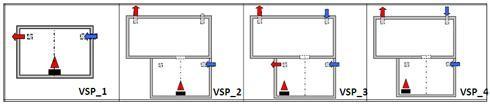
It comprises four tests:
- the first test (VSP_1), known as the reference test, is carried out in the lower room alone, with a centralised fire source and a fixed ventilation flow rate
- the second test (VSP_2) is carried out with the same fireplace and the same ventilation flow rate as for the reference test, but with a connection to the upper room. The latter is open just above the fireplace and, on this occasion, smoke extraction takes place via the upper room
- The third test (VSP_3) differs from the previous one in that the fire is positioned off-centre and in that smoke extraction and fresh air intake are implemented in each of the two rooms
- The final test (VSP_4) is identical to the previous one except that, on this occasion, there is no longer any smoke extraction in the lower room.
Fire spread via cable trays (CFS)
This CFS (Cable Fire Spreading) campaign investigates the spread of fire between several stacked cable trays and from an electrical cabinet to cable trays above, as well as the spread of smoke from the fire room to an adjacent room.
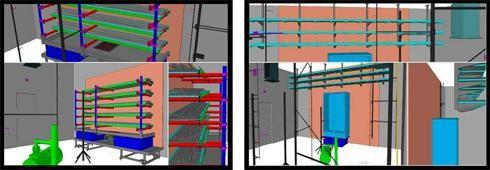
It comprises two series of tests:
- tests CFS_1 to CFS_4 concern the spread of fire between five stacked cable trays; they plan to test three types of cable and two levels of ventilation
- tests CFS_5 to CFS_7 investigate the spread of fire from an open electrical cabinet to three cable trays located above. For these tests, a third room will be used specifically to study the effects of pressure on a fire door (connecting a third room to the room adjacent to the fire room).
These tests are representative of fire scenarios in nuclear facilities, initiated, for example, by an electrical fault in a control panel or an electrical cabinet.
Sprinkler fire suppression (FES)
The FES test campaign (Fire Extinguishing System) aims to evaluate the performance of water spray fire extinguishing systems. In four to six tests (FES_1 to FES_6), the effectiveness of two or three types of industrial sprinkler nozzles will be assessed for two water flow rates, under conditions representative of fires in confined and ventilated environments. The effectiveness assessment covers the cooling of the ambient environment and the extinguishing of the fire source.
PRISME 1
Project characteristics : Program carried out under the auspices of the OECD, with the IRSN acting as the operating agent.
Dates : 2006 –June 2011
Funding : €7 million
Partners :
- AVN, TRACTEBEL (Belgium)
- VTT, STUCK (Finland)
- GRS, iBMB (Germany),
- EDF, DGA, ASNR (France)
- AECL (Canada)
- JNES (Japan),
- VROM, KFD, NRG (Netherlands)
- SKI, Ringhals AB (Sweden)
- CSN (Spain)
- HSE (United Kingdom)
- KINS (Korea)
- NRC (United States)
The aim of the program PRISME was to study the various mechanisms involved in the spread of hot gases and smoke from a burning room to adjacent rooms, through all kinds of openings (open doors, gaps in closed doors, ventilation holes, pipes, etc.), and under the influence of ventilation.
-
To this end, two types of tests were carried out:
- Tests designed to study a specific physical phenomenon (known as ‘separate effects’), such as flow patterns around an open door
- so-called comprehensive tests, which consist of fires in a configuration representative of nuclear facilities.
-
The first three campaigns were dedicated to the study of separate effects:
- PRISME Source for characterising fire sources
- PRISME Door to study the spread of heat and smoke through open doors
- PRISME Leak to study the spread of heat and smoke through openings (openings, leaks through a fire door, ducts passing through the fire compartment).
Finally, the last campaign, PRISME Integral, involved conducting comprehensive tests based on various accident scenarios.
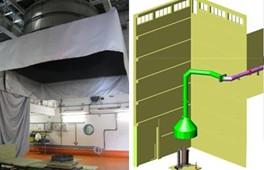
The tests fire source characterization was carried out in an open environment under the SATURNE hood, a calorimeter designed for studying fire sources in a free atmosphere and located at the site ASNR in Cadarache. They involved burning hydrocarbon sheets, electrical cabinets or cables, with a particular focus on determining the fire’s heat release rate.The other tests were carried out in the full-scale DIVA facility, also located at the Cadarache site, which consists of three rooms and a corridor that is enclosed and ventilated in the same way as nuclear facilities. Fires are studied there throughout their development until they are extinguished due to a lack of fuel or oxidiser.
-
Five experimental campaigns were conducted between early 2006 and mid-2011, comprising more than 35 full-scale experiments.
The PRISME Source campaign utilised a single ventilated room. It reproduced the effect of oxygen depletion, caused by atmospheric contamination, on how the intensity of a hydrocarbon pool fire evolves as a function of the ventilation flow rate.
Subsequent experimental campaigns focused on the flow of smoke and hot gases through open doors between two or three rooms, ventilation openings or leaks in a fire door. Finally, so-called tests were carried out full-scale’, in which all parts of the facility were utilised, involving complex fire sources as well as the activation of fire-extinguishing systems (notably sprinklers) or fire dampers on the ventilation system.Effect of ventilation on fire intensity
The PRISME program has provided a better understanding of the effect of ventilation on the intensity of a fire that breaks out in a confined, ventilated room, and in particular on the duration of the fire.
Depending on the ventilation air change rate, the fire may extinguish rapidly due to the decrease in oxygen concentration within the burning room. However, PRISME tests have shown that a balance can be established between the air entering through the ventilation outlet and the intensity of the fire: the fuel then burns slowly and completely. For example, the same fire can last 2.5 times longer than in an open atmosphere in a room ventilated at a rate of 4.7 air changes per hour. The key contribution of developments in cable fire testing is a better understanding of the effect of oxygen deprivation on the evolution of fire intensity.Mixed convection
The PRISME program has also made it possible to quantify the effect, on smoke propagation, of ‘mixed’ convection, which combines forced convection created by ventilation and natural convection induced by the high temperature of the smoke.
Mechanical ventilation of the burning room can significantly alter the gas flows that naturally establish themselves at an open door between two rooms.
Depending on the ventilation system, mechanical ventilation contributes to unbalancing the inflow and outflow from the burning room, and to shifting the position of the neutral plane (the height at which flow velocities are zero due to the reversal of flow rates) at the door.New models for software
The volume of data collected during this program has enabled the assessment of the software’s ability to simulate different fire scenarios.
The new models, particularly those for pyrolysis, have been implemented in the software of the various partners (the SYLVIA and ISIS software for the ASNR) and validated using the experimental data obtained during this program.
In addition, software intercomparisons were organised by the ASNR as part of a group linked to the PRISME program.
The various partners compared the results of fire simulations with experimental data. In particular, this group tested and analysed several ‘metrics’ – indicators used during the validation process to objectively assess the discrepancies between experimental data and simulation results.
Among those recommended by the standards, two metrics proved to be complementary in assessing the software’s ability to simulate a fire:- The first metric assesses the relative difference between numerical and experimental results for local values, such as extrema
- The second metric is the normalised Euclidean distance, which allows the discrepancy between numerical and experimental results to be assessed over the duration of the fire. This metric acts as a measure of overall error.
A sensitivity study was also carried out using six different simulation software packages, including the IRSN’s SYLVIA. The influence of six input parameters (fire power, radiative fraction of the flame, thermal properties of the walls, etc.) was tested for the calculation of nine quantities of interest (gas and wall temperatures, oxygen concentration, heat fluxes, etc.). For all software packages, the results show that the most influential input parameter is fire power, highlighting the need to continue efforts to improve its modelling.