IRSN publishes a study on social consequences of the 3/11 nuclear accident in Fukushima prefecture

Introduction
Result of the French-Japanese research project Shinrai, the report "The 3/11 accident and its social consequences - Case studies in Fukushima prefecture" analyses post accidental policy in Fukushima prefecture, particularly the questions linked to return or non-return to evacuated towns and villages. The report also compares the concrete experience of the inhabitants and the decision-makers with a number of principles that underlies international post accidental policy and recommendations.​

Result of the French-Japanese research project Shinrai, the report "The 3/11 accident and its social consequences - Case studies in Fukushima prefecture" analyses post accidental policy in Fukushima prefecture, particularly the questions linked to return or non-return to evacuated towns and villages. The report also compares the concrete experience of the inhabitants and the decision-makers with a number of principles that underlies international post accidental policy and recommendations.​

Download IRSN Report 2019/00178: Shinrai research Project: The 3/11 accident and its social consequences. Case studies from Fukushima prefecture


Eight years after the Fukushima Daiichi nuclear accident in Japan, IRSN publishes a report on its social consequences. This research is based on an intensive field work carried out by researchers with inhabitants of the Fukushima prefecture. The Institute investigates this topic within the framework of the Shinrai project​, a French-Japanese research program coordinated by IRSN with the participation of Sciences Po Paris and To​kyo Tech.

The framework of this research is inscribed in the field of disaster studies, with a multidisciplinary approach (anthropology, political sciences, sociology) in order to analyze the trust of Japanese citizens towards the government in charge of dealing with the crisis. Between 2014 and 2017, researchers from IRSN and Sciences Po completed 118 interviews during 8 missions of 2 to 3 weeks:​

  • ​​​Inhabitants of the Watari quarter in Fukushima city (60 km from t​he crippled Fukushima Daiichi nuclear power plant), the town of Naraha and the village of Kawauchi, who were allowed to return or not to their hometown after the lifting of evacuation orders (EOs) by the Japanese government (see interactive map below),

  • Government and local representatives to better understand the policy of lifting of EOs after decontamination,

  • ​Non-Profit Organizations (NPOs) or independent experts, who played an important role in informing and supporting the population.


Despite decontamination and the lifting of EOs, the rate of returnees is relatively low. The fieldwork identified six broad categories of inhabitants in relation to their decision to “whether return or not” after the lifting of EOs. This categorization shows the diversity of situations, depending on age, family status - for example, family with children -, commitment to the post accidental policies, confidence in the assessment of radiological situation by government experts.


Decision

Explanations

Return and forget/resist

They see their return as a relief after a number of relocations and they have no hesitation to come back. This category is primarily composed of seniors settled for several generations in rural areas. They seem to be the least "affected" by the consequences of the accident. They are reluctant to follow the radiation protection advice given by the local authorities because they want to live as much as possible "as before". However, in some families, children and grandchildren have not returned or refuse to visit grandparents.

​​​​Return and control/comply

​​They return after the lifting of evacuation orders. They comply with advice given on radiation protection by local authorities, and the possibility to measure radioactivity plays a key role for this category of inhabitants. They have an overall confidence in the post accidental policies, including the measures taken by the authorities to reduce ionizing radiation.

Return and worry

​​People who return but who have doubts about the radiological situation. They are not sure of having taken "the right decision", which causes great anxiety. The end of the entitlement to statutory monthly compensation payment one year after the lifting of EOs has been felt as a push from the authorities. Another form of pressure is the need to be "loyal" to their hometown. This category is essentially composed of families with young children.

Return and commute

​​Some inhabitants come back to work in hometowns while living in the place they were evacuated to. This choice is a source of tension and disagreement with those who have chosen to return "fully". This alternative migratory choice has not been officially recognized by the government or local authority. The government has basically offered only two options to the evacuees after the accident: return with support to restart their lives, or resettle in other places on their own.

Not returning for the moment

They do not return for the moment, but they plan to come back to their hometown at some point in the future. Their evacuation is presented as a (long) parenthesis. Not returning for the moment can be justified by the need to protect children from contamination. A return later can be linked to a later life project of taking care of elderly parents, who have already resettled.

Not returning ever

This category of inhabitants does not plan to come back, ever, to Fukushima prefecture. They have, to a certain extent, made a fresh start, and developed in most cases a deep mistrust towards the authorities. Protecting children from radioactivity explains their decision. A choice that is not always shared within families, resulting in many cases of divorces. Non return has sometimes triggered the sense of citizenship, or even political engagement: some become vocal against the post accidental policy led by the government.


​​The research highlights the role of local elected representatives, in this case the mayors, by showing how they sought to meet both government requirements and the wishes of their constituents. It also addresses the ethical dilemmas that politicians, authorities and government experts have faced: is it legitimate to reassure the population at all costs? How to decide when the interests of the inhabitants question the notion of "community" conceptualized as a homogeneous set of persons? 

The report concludes by comparing co​ncrete situation in Fukushima with a number of principles that underlies international post accidental policy and recommendations. This report identified three ways to fuel the reflections in the French and international bodies in charge of managing the post accidental phase:

  • ​The attachment of the inhabitants to their hometown, observed after the Chernobyl accident, was not verified in Fukushima. However, this is an assumption underlying post accidental policy, as noted in Publication 111 of ICRP, the international body responsible for radioprotection recommendations. The decision of the Japanese government to "reconquer" the territories by entrusting their decontamination to private companies is appreciated by those who wish to return, but denounced by those who would have preferred that the money be invested otherwise (allowing a final relocation for example).

  • The commensurability of radiological risk with other risks (tobacco, alcohol or natural risks specific to Japan). This rationale is recurrent in the discourses of radiological protection but shows some limitations in the aftermath of the Fukushima nuclear accident. While this principle is acceptable to some inhabitants, it is radically dismissed by others, who cannot put in balance the health of their children or accept this​ “balanced” approach.

  • The designation of zones as a tool for radiation protection of populations. This pillar of Japanese post accidental policy was based on the international regulation and recommendation framework established by ICRP and IAEA. However, zoning choices have been questioned, including their definition based on the level of radioactivity measured or estimated for the future.​​​


Download IRSN Report 2019/00178: Shinrai research Project: The 3/11 accident and its social consequences. Case studies from Fukushima prefecture


About the Shinrai project

​Shinrai ("confidence", in Japanese) is a French-Japanese research project started in 2014. Led by IRSN with the participation of Sciences Po Paris and Tokyo Tech, it aims to investigate the decision making methods used by authorities following the accident and their impact on the population.

The project studies the role of public authorities, their trustworthiness (ability to meet the confidence of citizens) and their accountability (ability to account to their own decisions), including in a context when scientific data alone do not allow to proceed and legitimize decisions.

Thème

IRSN contributes to three new NEA projects to prepare the decommissioning of Fukushima Daiichi's damaged reactors

Introduction
The three new research projects launched by Japan will be conducted under the auspices of the OECD's Nuclear Energy Agency (NEA). Along with its NEA peers, IRSN will share its tools and methods on severe reactor accidents.

Along with their NEA peers, a number of IRSN experts will contribute actively to three projects to prepare for the decommissioning of the damaged Fukushima Daiichi reactors: one project to prepare the recovery and analysis of fuel debris (PreADES PreADES [http://www.oecd-nea.org/jointproj/preades.html]), another to examine the state of the damaged reactors (ARC-F) in more detail, and another to thermodynamically characterize the fuel debris and fission products (TCOFF).

IRSN intends to share its expertise internationally: by contributing to the synthesis of knowledge acquired from the Fukushima Daiichi accident, by contributing its expertise to the analysis of debris samples from the damaged reactors, by upgrading its thermodynamic databases (NUCLEA, MEPHISTA).

IRSN expects that its participation in these three projects will help to strengthen its expertise capacity on severe accidents: it will gain a better understanding of the limits of the various tools and methods it has developed through its studies and research, by applying them to the reality of an accident that has been thoroughly analyzed.

Nuclear safety: successful test in the CABRI experimental reactor for the CIP programme

Introduction
On 16 April 2018, IRSN and the CEA successfully completed a first test simulating an accident situation in the Cabri reactor at Cadarache as part of an experimental programme. This experiment was conducted on a new pressurised water loop and is the first step in the CIP international research programme to improve reactor safety.

On 16 April 2018, IRSN and the CEA successfully completed a first test simulating an accident situation in the Cabri reactor at Cadarache as part of an experimental programme. This experiment was conducted on a new pressurised water loop and is the first step in the CIP international research programme to improve reactor safety.


Purpose of the test

The Cabri International Programme (CIP) seeks to improve knowledge of fuel behaviour in pressurised water reactors (PWR) during an accident involving a sudden increase of power in the reactor. The first test under the programme was conducted on 16 April 2018, on the renovated CABRI reactor, equipped with an experimental pressurised water loop [1]. This loop will be used to analyse fuel behaviour in a thermal-hydraulic configuration, representative of a PWR. The instrumentation installed by IRSN in the CABRI reactor can take vital measurements for interpreting tests. The Hodoscope is the only equipment of its kind in the world to provide real-time measurements of the power along the rod tested, its elongation and any potential fuel relocation.

The purpose of the first test is to ensure that the new loop works properly, study boiling following heat transfer from the fuel rod to the water, and the behaviour of fuel in the event of sudden and mass heat injection.

According to Jean-Christophe Niel, Director General of IRSN, “the next step in the programme hinges on testing the irradiated fuel rods in an environment as close as possible to that of a pressurised water reactor core. These conditions have never before been created in this kind of experiment. The aim is to obtain the knowledge required to assess the safety of PWR reactors.” The test will study heat exchange between the coolant and rod cladding, along with the thermal interaction between the ejected fuel fragments and water in the event of cladding rupture.

IRSN research on fuel behaviour in accident situations

IRSN research focuses on fuel behaviour under various accident situations that could affect pressurised water reactors:

  • uncontrolled development of the nuclear reaction resulting from ejection of a control rod assembly formed of absorbent rods that help control the nuclear reaction;
  • loss of coolant accident (LOCA) caused by rupture of the reactor coolant pressure boundary;
  • dewatering of a spent fuel pool, in particular subsequent to feedback from the Fukushima-Daiichi accident.

These research projects are essential for developing the expertise of IRSN teams.

Jean-Christophe Niel underlines that “these research projects have objectives shared by the international community and need to promote partnerships in France and abroad with IRSN counterpart institutions, in particular the ETSON network [2], and with research bodies such as the CEA, with whom we are working hard to ensure the success of the Cabri International Programme (CIP).

In addition to the experimental programmes conducted in the CABRI reactor, IRSN research draws on a large database of international experiments, comprising results from reactor tests (NSSR in Japan, BIGR in Russia, etc.) and analytical tests on cladding behaviour and heat transfers. IRSN is also participating in a number of international research programmes, in particular an OECD project in Halden, Norway, and another in Studsvik, Sweden. It is also carrying out projects funded by the French National Research Agency (ANR) in a post-Fukushima context, on fuel behaviour in a spent fuel tank in the event of dewatering, and on the coolant of a fuel assembly deformed during a LOCA. In addition to large-scale tests under representative conditions, earlier work is carried out with academics to develop and approve the models later integrated into simulation software used for safety studies.


Notes:

  1. Two initial tests were conducted in a “sodium” loop before renovation of the reactor and the development of the pressurised water loop. It will be possible to compare these results with results from the tests conducted in the pressurised water loop.
  2. The main role of technical safety organisations (TSO) is to scientifically assess the safety of nuclear facilities and the radiation risks. Within the international network, Etson, they now also work on research, discussions concerning future choices, training and even communication with society on nuclear and radiation risks.

CEA CABRI research reactor at Cadarach

The CEA operates the CABRI research reactor on behalf of IRSN. It is its experimental facility to study the behaviour of nuclear fuel in the event of an accidental power increase, located at the CEA Cadarache research centre in the South of France (Bouches-du-Rhône).

The reactor was built in 1962 and has been adapted since its construction for the purposes of safety studies on French nuclear facilities, from fast neutron reactors to recent pressurised water reactors.

It has therefore undergone a major renovation programme (civil engineering, fire protection, etc.) in order to comply with current safety standards and install an experimental pressurised water loop. As acknowledged by François Gauché, Director of Nuclear Energy at the CEA, “this renovation programme required significant resources from the CEA and IRSN over a long period of time. This first pressurised water loop test is a token of our collective success.”

One specific property of the CABRI reactor is the rod system in its core, which uses an ultra-rapid depressurisation phenomenon to change the reactor power by a factor of around 200,000, from 0.1 MW to 20,000 MW in just a few milliseconds, for a very short duration of 10 to 100 ms.


About the CEA

The CEA is a public research body that works in four fields: defence and security, nuclear and renewable energies, technological research for industry and fundamental research. Drawing on its widely acknowledged expertise, the CEA actively participates in collaborative projects with a large number of academic and industrial partners. With its 16,000 researchers and staff, it is a major player in the European Research Area and its international presence is constantly growing. www.cea.fr

About IRSN

IRSN is a public body with industrial and commercial activities (EPIC). Its missions are now defined by French Act no. 2015-992 of 17 August 2015 on the energy transition for green growth (TECV). It is the public expert in France on nuclear and radiation risks. IRSN contributes to public policy on nuclear safety and human and environmental protection against ionising radiation. It is a research and assessment body, working with all players affected by these policies, while retaining its independent position. IRSN operates under the joint authority of the Ministries of the Environment, Research, Energy, Health and Defence.

Health consequences of low-dose radiation exposure in the context of a nuclear accident

Introduction
first results from the EPICE program in the Russian territories contaminated by the Chernobyl fallout

The epidemiological study EPICE provides well-documented answers regarding non-cancerous radiation-induced effects. This study does not observe an association between cardiac arrhythmia and caesium-137 deposition levels on children living in the Bryansk region exposed to Chenobyl fallout.

The scientific evidence currently available about the possible health consequences of accidental exposure to ionizing radiation is mainly based on lessons learned from the follow-up of A-bomb survivors (Hiroshima and Nagasaki) in Japan, as well as populations exposed to fallout from the Chernobyl accident in Belarus, Ukraine and Russia. The observed effects vary according to the type of radiation exposure, dose rate and study population.

In the long term (a few years to decades), an increase in the risk of leukemia and cancers has been observed among the Japanese survivors of the Hiroshima and Nagasaki bombings, as well as an increase of thyroid cancer in children exposed to fallout from the Chernobyl accident in Belarus, Ukraine and Russia.

With respect to non-cancerous effects, a relationship between the risk of cardiovascular disease and exposure to ionizing radiation was observed in the survivors of the Hiroshima and Nagasaki bombings and in Chernobyl liquidators; a similar observation was made for lens opacities (early stage of cataract) and exposure. However major uncertainties remain over the existence of such low-dose associations.

To address this issue, IRSN set up in 2005 the EPICE program (Evaluation of Pathologies potentially Induced by chronic CEsium contamination) in order to gather scientific information on non-cancerous effects resulting from chronic low-dose ionizing exposures and to answer a societal question relating to the health consequences of the Chernobyl nuclear accident in a sensitive population (children).

Territories and population included in the EPICE study

Territories and population included in the EPICE study

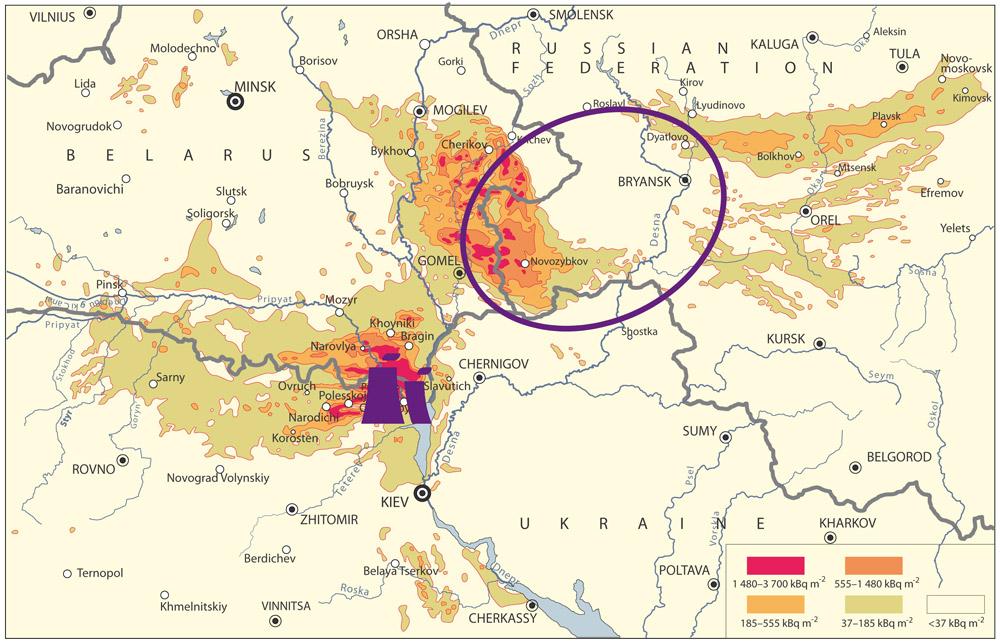
© UNSCEAR  - caesium-137 soil deposition

The region of Bryansk, in Russia, is located to the north-east of the Chernobyl nuclear power plant. Part of the region was affected by the Chernobyl fallout. The EPICE study focused on systematic screening for cardiac arrhytmias in nearly 18,000 children aged 2 to 18 living in the contaminated (137Cs deposit > 37 kBq/m²) and uncontaminated territories of the Oblast.

Children included in the EPICE analysis

After a pilot phase to demonstrate the feasibility of the project and to determine conditions for the implementation of an epidemiological study in a population of several thousand children, the second part of the EPICE program focusing on cardiac arrhythmias started in May 2009 in collaboration with Bryansk Diagnostic Center (Russia).

The purpose of this cross-sectional study was to determine the prevalence  of cardiac arrhythmias (in terms of the territory contamination and caesium-137 whole-body burden in the study population) in the southwestern part of Russia close to the Ukrainian and Belorussian borders, and to assess whether or not caesium-137 was an associated factor in the occurrence of cardiac arrhythmias.

To solve these questions, a measurement campaign was conducted on 18,152 children aged 2 to 18 years old during four years. It consisted of performing systematically an electrocardiogram, a cardiac ultrasound and an assessment of the caesium-137 whole-body activity for the entire population of the study. In addition, some children also benefited from a 24-hour monitoring of cardiac electrical parameters (Holter) as well as a biological assessment of major plasma cardiac biomarkers.

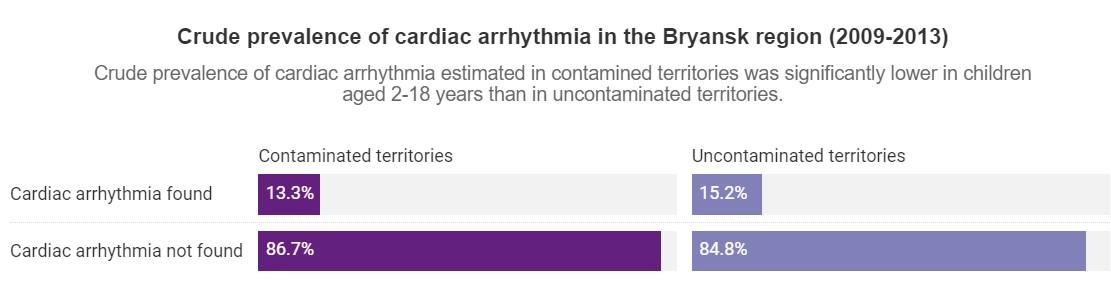
Crude prevalence of cardiac arrhythmia in the Bryansk region (2009-2013)

Crude prevalence of cardiac arrhythmia in the Bryansk region (2009-2013)
Crude prevalence of cardiac arrhythmia estimated in contamined territories was significantly lower in children aged 2-18 years than in uncontaminated territories.

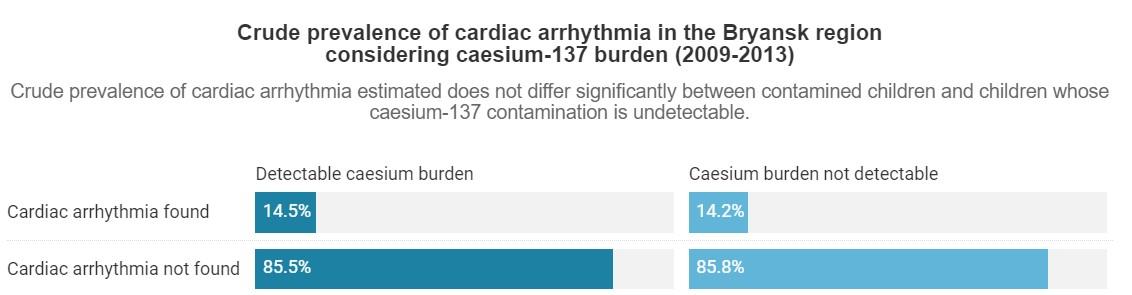
Crude prevalence of cardiac arrhythmia in the Bryansk region considering caesium-137 burden (2009-2013)

Crude prevalence of cardiac arrhythmia in the Bryansk region considering caesium-137 burden (2009-2013)
Crude prevalence of cardiac arrhythmia estimated does not differ significantly between contamined children and children whose caesium-137 contamination is undetectable.

All of these medical examinations diagnosed 2,526 children with cardiac arrhythmia. As a result of a thorough statistical analysis of the data collected on the field, over the period 2009-2013, the prevalence of cardiac arrhythmias estimated in the contaminated territories is significantly lower than in the controlled territories. With regard to caesium-137 whole-body burden, no association could be demonstrated. Therefore, caesium-137 is not an associated factor in the occurrence of cardiac arrhythmia in the frame of the study.

This epidemiological study, which is unique in terms of its size and the quantity of data collected, thus provides well-documented answers regarding non-cancerous radiation-induced effects in children living in Russian contaminated territories by the fallout from the Chernobyl accident, issue which is widely discussed for many years.

This article, published in BMJ Open (open access version of the prestigious journal The British Medical Journal), is the first in a series of future publications on the results of the EPICE program, including the conclusions of a study on a large-scale screening of lens opacities in a similar group of children living in the same region of Russia.


Download the article published in BMJ Open Is exposure to ionising radiation associated with childhood cardiac arrhythmia in the Russian territories contaminated by the Chernobyl fallout? A cross-sectional population-based study” (PDF, 408 Ko)

28 recommendations to limit the consequences of nuclear accidents on the population

Introduction
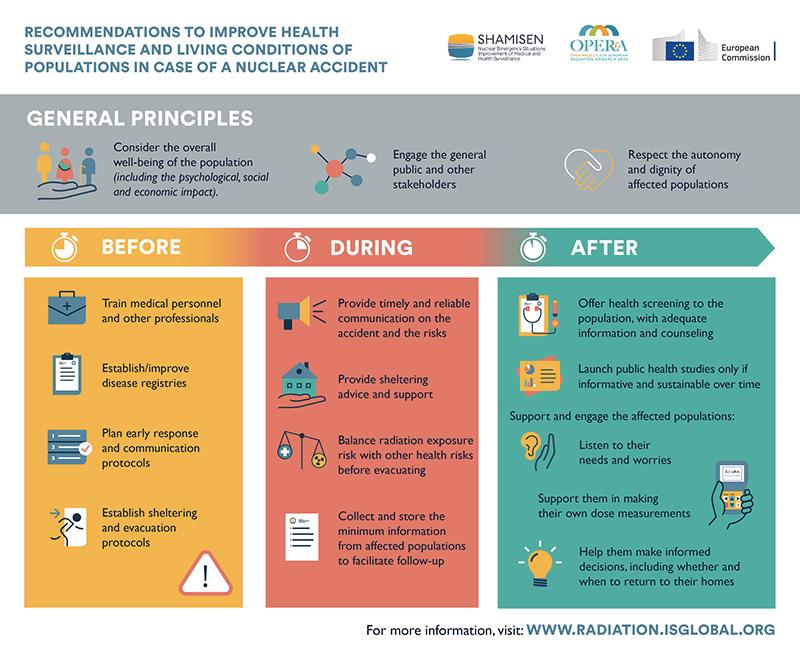
The guidelines presented at the final meeting of the European Shamisen project underlines the importance of involving population in the management of an accident and taking into account the economic and social upheavals and the psychological effects, particularly in the context of an emergency evacuation.​​

The guidelines presented at the final meeting of the European Shamisen project underlines the importance of involving population in the management of an accident and taking into account the economic and social upheavals and the psychological effects, particularly in the context of an emergency evacuation.​​

Download the report Recommendations and procedures for preparedness and health surveillance of populations affected by a radiation accident​ (PDF, 338 Ko)​

What to do or not to do in case of a nuclear accident? How to improve the health surveillance and living conditions of affected population? Because the decisions taken at the time of the Chernobyl and Fukushima accidents sometimes "did more harm than good", the European Commission funded the Shamisen project, a research program that brought together 19 European and Japanese organizations including IRSN, as well as American, Belarusian, Russian and Ukrainian experts. ​

Resarchers agreed to set 28 recommendations to improve the emergency and preparedness to a nuclear accident, the early and intermediate phase and the long-term recovery phase. General principles that can be applied to other types of accidents and disaster have also been identified.

Recommendations and procedures for preparedness and health surveillance of populations affected by a radiation accident​​
Shamisen projet have been cofounded by the European commission in the frame of the OPERRA project (FP7, grant agreement 604984)

The guidelines aim to extend the management of the nuclear accident beyond the protection of population from exposure to ionizing radiation alone. Measures such as the emergency evacuation have important psychosocial that must be taken into account.

To summarize, the recommendations focus on three main objectives (see infographics above to involve affected populations in the decision making process alongside experts and authorities:

  • Take in​to account the well-being of the affected populations;
  • Foster participation of affected population and other stakeholders such as medical staff;
  • Respect the autonomy and dignity of the affected populations.

All major aspects on nuclear accident management are concerned: evacuation of populations, measurement and dose assessment, health surveillance, epidemiological studies and communication.

For example, local facilitators should make the link between the experts and the affected populations to allow everyone to make a choice based on reliable, timely and up-to-date information. Population should also be encouraged to participate freely in epidemiological studies in order to improve their relevance, efficiency and acceptability. However, it is important to ensure that these studies are informative and sustainable over time the findings are communicated in a clear understandable language to all concerned.

Some of the recommendations of the S​​​hamisen project have already been implemented in France and are included in the French National Plan for Response to a Major Nuclear or Radiological Accident published in February 2014.​

First results in a research program on risks of explosion associated with unstable compounds "red oils" in reprocessing plants

Introduction
Complex reactions occur between the compounds used for the treatment of spent fuel. They can lead, under certain conditions, to the formation of unstable compounds known as "red oils". At some point, there is a danger of thermal runaway and explosions like in the Savannah River reprocessing plant (USA) in 1953 and in the Tomsk-7 industrial complex (Russia) in 1993.

Complex reactions occur between the compounds used for the treatment of spent fuel. They can lead, under certain conditions, to the formation of unstable compounds known as "red oils". At some point, there is a danger of thermal runaway and explosions like in the Savannah River reprocessing plant (USA) in 1953 and in the Tomsk-7 industrial complex (Russia) in 1993.

In 2017, IRSN will complete a research program to understand in depth the thermal runaway phenomena and the parameters leading to it. The research program aims to define appropriate operating procedures to prevent the phenomena. It also seeks to improve safety provisions used to control this type of risk.

Since its start in 2012, the program is also supported by Areva NC, the operator of the spent fuel reprocessing plants in La Hague in Normandy, and the public government-funded research organization CEA.

First results in the research program led to recommendations issued by IRSN during the safety review for the UP3 spent fuel reprocessing plant in La Hague (Report in French).

The Institute has requested that risk analysis be supplemented by taking into account accident situations associated with red oils. For its part, Areva proposed to improve the procedures in existing fission product concentration units as well as technical changes for future units.

IRSN also develops a simulation tool named “ALAMBIC” intended to model red oils phenomena. The parameters used in this tool will be validated with data obtained with the current research program.

More information: Read the technical note of IRSN of June 2008 about Risks of explosion associated with "red oils" in reprocessing plants”

Generation II and III reactors: safety-related research proposals under the H2020 European Framework Program underway

Introduction
NUGENIA, the European association for research on Generation II and III nuclear reactors, gathered 260 participants in April 2016 in Marseille. The meeting gave IRSN and its partners the opportunity to discuss the projects they plan to propose in response to the call for projects 2016-2017 launched by the European Commission, under the H2020 Framework Program.

NUGENIA, the European association for research on Generation II and III nuclear reactors, gathered 260 participants in April 2016 in Marseille. The meeting gave IRSN and its partners the opportunity to discuss the projects they plan to propose in response to the call for projects 2016-2017 launched by the European Commission, under the H2020 Framework Program.

The meeting, to which the European Commission and the AIEA were invited, provided an opportunity for IRSN and members of NUGENIA to discuss also ongoing projects selected in the first call for projects for 2014-2015.

The program for this second call for projects, like the first one, focuses largely on research relative to generation II reactors built up to the end of the 1990’s and generation III reactors such as EPR under construction in Normandy, France.

The subjects discussed by the key partners included extending the service life of current nuclear power plant, passive safety systems for generation II and III reactors, small modular reactors, and severe reactor accidents and their consequences.

Work on finalizing the safety-related research proposals is now underway for submission this fall. The European Commission will notify the results in March 2017.


More informations: Website of NUGENIA - NUclear GENeration II & III Association

Research reactor CABRI restarts after an important upgrade

Introduction
The CABRI research reactor has once again achieved criticality after several years of renovation and modification work. Operational preparation for the CABRI International Program (CIP) for the study of reactivity accidents can now go ahead. Led by IRSN under the aegis of the NEA, CIP involves 18 partners from 12 countries.

The CABRI research reactor has once again achieved criticality after several years of renovation and modification work. Operational preparation for the CABRI International Program (CIP) for the study of reactivity accidents can now go ahead. Led by IRSN under the aegis of the NEA, CIP involves 18 partners from 12 countries.

The divergence of the CABRI research reactor in October 2015 is the culmination of several years of renovation and modification of the facility. This achievement was the last technical step prior to the operational implementation of the Cabri International Program (CIP), an international research program led by IRSN under the aegis of the OECD NEA and devoted to reactivity initiated accident experiments.

During a reactivity accident, some of the fuel assemblies making up the reactor core can be subject to a significant power surge for a few milliseconds, exposing the fuel elements to extreme loads, which may cause their destruction. It is therefore essential to verify experimentally the effects of such loads on fuel elements, in order to understand safety margins and adapt regulatory safety criteria where necessary. This is the goal of the fuel tests conducted in CABRI, a reactor with outstanding characteristics which make it unlike any other facility in the world.

CABRI is designed to produce rapid power transients. Its new water loop reproduces the pressure (155 bar) and temperature (280°C) conditions observed in a pressurized water reactor, so it can be used to study all the physical phenomena(7) involved in a reactivity accident, along with their interactions. The CIP program consists of ten tests on different types of fuel (UO2 or MOX) at different burnups, using different cladding materials. Among other things, the program will provide a fuller understanding of thermal and mechanical processes that are observed in the fuel rods and that can impair their integrity, in particular during the advanced phase of the accident.

Learn more: summary of the CABRI research program

Research: new results of the epidemiological study INWORKS on cancer risk among workers in the nuclear industry

Introduction
New research results of the epidemiological study INWORKS published today reinforce the evidence of the existence of a relationship between risk of death from cancers other than leukemia and exposure to ionizing radiation. These results complete the first results of INWORKS published in June 2015 regarding leukemia risk.

New research results of the epidemiological study INWORKS published today reinforce the evidence of the existence of a relationship between risk of death from cancers other than leukemia and exposure to ionizing radiation. These results complete the first results of INWORKS published in June 2015 regarding leukemia risk.

INWORKS is an epidemiological study of mortality among workers in the nuclear industry coordinated by the International Agency for Research on Cancer (IARC www.iarc.fr) and involving IRSN, NIOSH (National Institute for Occupational Safety and Health www.cdc.gov/niosh) for the United States, the PHE-CRCE (Public Health England's Centre for Radiation, Chemical and Environmental Hazards www.gov.uk/government/organisations/public-health-england) for the United Kingdom, the University of North Carolina (UNC www.unc.edu) and the Center for Research in Environmental Epidemiology (CREAL www.creal.cat).

The study combines cohorts of French, American and British workers in the nuclear industry (fuel preparation, research, power generation, reprocessing of spent fuel) and monitored for external radiation exposure by wearing individual dosimeters. The population studied in INWORKS includes more than 300,000 workers, male and female employees from the mid-1940s. The French cohort of more than 59,000 individuals included in INWORKS brings together workers of AREVA NC, the CEA and EDF.

INWORKS aims to verify the validity of the assumptions underlying the current system of radiation protection of workers which is based on an extrapolation of knowledge of radiation-induced risks derived from the epidemiological monitoring of survivors of the atomic bombings of Hiroshima and Nagasaki. This is the largest epidemiological study ever conducted to quantify the health risks potentially associated with chronic exposure to low doses of ionizing radiation.

In June 2015, the first results of INWORKS reinforced the evidence of the existence of a relationship between leukemia risk and exposure to ionizing radiation (cf. our news report of 23 June 2015).

New research results published today on the website of the British Medical Journal concern the risk of death from cancers other than leukemia.


Download IRSN information note of 21 October 2015: Publication of new results of the epidemiological study INWORKS on the risk of cancer among nuclear industry workers chronically exposed to low doses of ionizing radiation

Download IRSN information note of 23 June 2015: Publication of the first results of the epidemiological study INWORKS on the risk of leukemia and lymphoma in the nuclear industry workers chronically exposed to low doses of ionizing radiation

Thème

Cooling and stabilizing corium: IRSN initiates new research on the mitigation of core degradation in a damaged reactor

Introduction
IRSN has recently launched a national program of experiments called PROGRES to determine how agglomerations of debris in a reactor core could be cooled by injecting water into the vessel.

IRSN has recently launched a national program of experiments called PROGRES to determine how agglomerations of debris in a reactor core could be cooled by injecting water into the vessel.

Retaining the corium resulting from a core meltdown accident within the reactor vessel or containment represents a major safety objective for the protection of people and the environment. 

For this reason, IRSN, as leader of the European IVMR project, has recently launched a national program of experiments called PROGRES to determine how agglomerations of debris in a reactor core could be cooled by injecting water into the vessel to enhance the retention strategy based on external vessel cooling.

Can the corium resulting from core degradation in a damaged reactor be cooled effectively enough to slow and prevent the progression of the accident towards total core meltdown and potential reactor vessel failure? Can it be stabilized and retained in the reactor vessel, even for higher power reactors (900 MWe and above)? 

Expected to run for five years under IRSN’s leadership, the European IVMR project (In-Vessel Melt Retention), which brings together 23 partners, raises key questions regarding corium behavior in the vessel in the event of a severe accident. 

In this context, one part of IRSN’s PROGRES program will study more specifically the cooling of the various types of debris agglomeration that may form in the vessel of a damaged reactor. Conducted at IRSN's PEARL facility, the program will subsequently extend beyond the vessel, assuming its failure. In fact, whether the debris bed is located inside the reactor core, at the bottom of the vessel or in the reactor pit, the phenomena surrounding corium cooling can be formulated in the same scientific terms.

This work forms part of a strategic IRSN goal – underpinned by the lessons learned from the Chernobyl and Fukushima accidents – to fill the remaining gaps in knowledge in order to help develop effective solutions to prevent, limit and control large radioactive releases in the event of a severe accident.

More information about the IVMR projet